
 فارسی
فارسی
 English
 العربية
 Русский

Viscosity is a term commonly discussed in fluid mechanics.
Viscosity is a property of fluids and is very important for studying fluid flow behavior. All fluids, whether liquid or gas, have a specific viscosity.
This article will provide more details on this term.
Click to order various types of epoxy resin and polyester resin.
**What is Viscosity?**
The term viscosity is rooted in the Latin word “Viscum,” which refers to stickiness.
In fluid mechanics, viscosity is defined as a measure of a fluid’s resistance to flow under an applied force.
For a fluid in motion, viscosity describes its internal friction. Therefore, a fluid with high viscosity exhibits greater internal friction resisting flow, while a fluid with lower viscosity creates less friction. Generally, liquids are more viscous than gases.
Considering the following example makes the concept of viscosity clearer. If we pour water and honey into a container, you will notice that water flows more smoothly and quickly than honey.
This is because honey is stickier than water. Consequently, honey offers more resistance to movement than water, which is why water flows more freely.
Click to order various types of epoxy resin and polyester resin.
**Importance of Viscosity**
A fluid’s viscosity opposes its fluidity, which indicates how easily a fluid can flow. This subject essentially concerns the internal friction between the molecules constituting the fluid. For fluid transport and lubrication, spraying, molding, and surface coating engineering, viscosity plays a primary role because it controls the flow of the liquid.
Knowing information about this viscosity is very important for predicting fluid behavior. For example, if tomato sauce inside a pipe does not have the appropriate viscosity, it might either not come out of the pipe or, conversely, flow too much.
**Symbol of Viscosity**
Mathematically, viscosity can be defined as the ratio of viscous stress to the rate of deformation. The symbol for viscosity is μ, the Greek letter mu. The symbol μ is widely used, but some physicists and chemists prefer to use η, the Greek letter eta, as the symbol for viscosity.
Click to order various types of epoxy resin and polyester resin.
**Measurement of Viscosity**
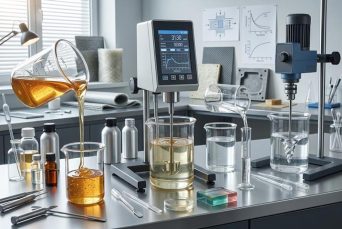
Measuring the viscosity of fluids is crucial for understanding their flow characteristics. Various types of instruments can measure viscosity. These measuring devices are known as viscometers and rheometers. Common instruments for measuring viscosity include:
– Capillary viscometer
– Falling sphere viscometer
– Rotational viscometer
– Acoustic rheometer
– Microfluidic rheometer
– Zahn cup
– Vibrational viscometer
– Fluorescence correlation spectroscopy
Click to order various types of epoxy resin and polyester resin.
**Factors Affecting Viscosity**
Various factors affect viscosity, including:
– **Pressure:** Increasing pressure usually increases the viscosity of gases. However, liquids are nearly incompressible, so pressure has little effect on them.
– **Fluid Temperature:** Generally, the viscosity of liquids decreases as temperature increases. In contrast, the viscosity of gases increases with increasing temperature.
– **Flow Conditions:** For laminar flow, the viscosity of the liquid remains constant, whereas for turbulent flow, the viscosity changes.
– **Multiphase Flow:** The viscosity of multiphase flow is influenced by the volume of each phase.
– **Suspended Particles:** These particles will increase viscosity.
**Viscosity of Water**
The viscosity of water at 20°C is 1 centipoise (cP). For liquids, viscosity decreases with increasing temperature. This also applies to water. The following table shows the dynamic viscosity of water at different temperatures.
| Temperature (°C) | Viscosity (cP) |
| :— | :— |
| 10 | 1.3059 |
| 20 | 1.0016 |
| 30 | 0.79722 |
| 50 | 0.54652 |
| 70 | 0.40355 |
| 90 | 0.31417 |
| 100 | 0.2822 |
**Kinematic Viscosity of Water**
The kinematic viscosity of water can be easily obtained by dividing the dynamic viscosity values above by the density of water, as shown in the following table:
| Temperature (°C) | Kinematic Viscosity (m²/s X 10⁻⁶) |
| :— | :— |
| 10 | 1.3059 |
| 20 | 1.004 |
| 30 | 0.801 |
| 50 | 0.553 |
| 70 | 0.413 |
| 90 | 0.326 |
| 100 | 0.294 |
Click to order various types of epoxy resin and polyester resin.
**Viscosity of Some Common Materials**
| Material | Temperature (°C) | Viscosity (cP) |
| :— | :— | :— |
| Benzene | 25 | 0.604 |
| Air | 25 | 18.5×10⁻³ |
| Mercury | 25 | 1.526 |
| Whole Milk | 20 | 2.12 |
| Olive Oil | 26 | 56.2 |
| Honey | 20 | 2,000–10,000 |
| Ketchup | 25 | 5,000–20,000 |
**Newton’s Law of Viscosity**
The relationship between shear stress and shear rate of a fluid under mechanical stress is established by Newton’s law. At a given temperature and pressure, Newton’s law of viscosity states that the shear stress between two adjacent layers in a fluid is proportional to the velocity gradient between those layers. Simply put, the ratio of shear stress to shear rate in a fluid is constant and is defined as the coefficient of viscosity. Newtonian fluids obey Newton’s law of viscosity.
Non-Newtonian fluids do not obey this law and consequently have different viscosities that depend on the shear rate. Dynamic viscosity is the coefficient of viscosity defined by this law.
**Practical Applications of Viscosity**
The concept of viscosity is used extensively in science and technology:
– The molecular weight of organic liquids is determined using viscosity.
– In lubrication engineering, viscosity data and its variation with temperature are essential for deciding the appropriate lubricant for specific equipment.
– Viscosity information is necessary for formulating various medicines, such as syrups.
– Cooking oils, fats, etc., are produced with a specific viscosity.
– Chewing gum, cleaners, coolants, brake fluid, cosmetics, etc., require viscosity information during production.
– Blood circulation in our bodies also depends on viscosity.
Click to order various types of epoxy resin and polyester resin.
**High Viscosity**
High viscosity generally means that the fluid is thicker. A fluid with high viscosity offers more resistance. For example, between water and honey, honey has a higher viscosity compared to water. Therefore, the resisting force against the flow of water will be less than that of honey.