
 فارسی
فارسی
 English
 العربية
 Русский

Epoxy resins have revolutionized various industries, and aerospace engineering is no exception. The unique properties of epoxy resins, such as high strength, light weight, thermal stability, and chemical resistance, make them indispensable in the aerospace sector. This comprehensive article explores the extensive applications of epoxy resins in aerospace engineering, highlighting their contribution to structural integrity, performance, and advancements in this industry.
**Composite Materials:**
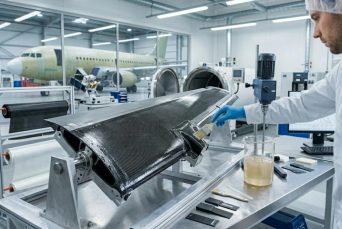
Epoxy resins are a key component in the production of advanced composite materials used in aerospace engineering. Composite structures, such as carbon fiber reinforced polymers (CFRP) and fiberglass composites, offer exceptional strength-to-weight ratios compared to traditional materials like aluminum. Epoxy resins act as the matrix material, binding the reinforcing fibers together and providing structural integrity for composite components, including wings, fuselages, and control surfaces.
**Structural Reinforcement:**
Epoxy resins play a crucial role in reinforcing critical structural elements in aircraft. They are used to bond various components, including metal joints, composite-to-composite joints, and honeycomb structures. The high adhesive strength of epoxy resins ensures secure bonding, contributing to the structural integrity and load-bearing capability of the aircraft.
**Weight Reduction:**
Weight reduction is a critical consideration in aerospace engineering because it directly impacts fuel efficiency, range, and payload capacity. Epoxy resins enable significant weight reduction due to their lightweight nature. By using epoxy-based composite materials, aerospace engineers can reduce the weight of aircraft components without compromising structural strength, leading to the construction of more fuel-efficient and environmentally friendly aircraft.
**Thermal and Fire Resistance:**
Aerospace applications often expose materials to extreme temperatures and fire hazards. Epoxy resins exhibit excellent thermal stability, making them suitable for components exposed to high-temperature environments, such as engine parts and aircraft interiors. Furthermore, epoxy-based materials can be formulated to meet stringent fire resistance regulations, enhancing the safety of aircraft interiors and reducing flame spread in the event of a fire.
**Aerodynamic Design:**
Epoxy resins are used in the construction of aerodynamic surfaces such as wings and fairings, helping to reduce drag and improve aircraft performance. Due to their design flexibility, epoxy-based materials can be easily shaped into complex geometries, resulting in efficient aerodynamic profiles. These components contribute to fuel efficiency, stability, and overall improved performance in aircraft.
**Repair and Maintenance:**
Epoxy resins play a significant role in the repair and maintenance of aircraft structures. They are used for patching and bonding damaged areas, reinforcing weakened structures, and repairing composite components. Epoxy-based repair materials offer high strength and compatibility with various substrates, enabling efficient and durable repairs, thus minimizing aircraft downtime and extending the aircraft’s service life.
**Electronics and Wiring:**
In aerospace engineering, where electrical systems are critical, epoxy resins encapsulate and protect electronic components and wiring. Epoxy-based compounds provide excellent electrical insulation properties, safeguarding sensitive electronics from moisture, vibrations, and environmental contaminants. These materials ensure the reliability and longevity of electrical systems in aircraft.
**Future Developments:**
Continuous research and development in epoxy resin technology drive advancements in aerospace engineering. Efforts focus on developing epoxy formulations with improved mechanical properties, higher temperature resistance, better flame retardancy, and greater fatigue resistance. These advancements will enable the construction of more efficient, safer, and more advanced aircraft.
**Fuel Tank Protection:**
Epoxy resins are also used in the aerospace industry to protect fuel tanks. As aircraft fuel tanks are subjected to various stresses including pressure, temperature changes, and vibration, epoxy coatings are applied to the internal surfaces of the tanks. These coatings create a protective barrier, preventing fuel leakage, corrosion, and the formation of harmful contaminants. Epoxy-based coatings ensure the integrity and safety of the fuel system.
**Satellite and Spacecraft Applications:**
Epoxy resins have found their way into satellite and spacecraft applications, where stringent performance requirements must be met. They are used in constructing satellite structures such as antenna reflectors and solar panels due to their lightweight and high-stiffness characteristics. Additionally, epoxy adhesives bond critical components and secure delicate electronic systems in spacecraft, ensuring reliability and performance in the harsh conditions of space.
**3D Printing:**
3D printing has opened new possibilities for the aerospace industry, and epoxy resins play a significant role in this field. Epoxy-based resins are used as materials for resin-based 3D printing techniques. This enables the production of complex geometries and custom parts with high precision and mechanical properties suitable for aerospace applications. Manufacturing 3D parts with epoxy resins allows for rapid prototyping, waste reduction, and increased design flexibility.
**Environmental Sustainability:**
In line with the industry’s increasing focus on sustainability, epoxy resins with improved environmental characteristics are being developed. Efforts are underway to reduce the environmental impact of epoxy resins by incorporating bio-based or recycled materials. These sustainable epoxy formulations aim to decrease the carbon footprint of aerospace engineering while maintaining desired mechanical and performance properties.
**Testing and Certification:**
The use of epoxy resins in aerospace engineering requires rigorous testing and certification processes to ensure compliance with industry standards and regulations. Epoxy-based materials undergo extensive testing for mechanical strength, fire resistance, thermal stability, and chemical compatibility. These tests validate the reliability and safety of epoxy resin applications in the aerospace sector, providing confidence to manufacturers and end-users.
**Collaboration and Research:**
The aerospace industry relies on collaboration between engineers, researchers, and materials scientists to continuously improve epoxy resin applications. Ongoing research focuses on optimizing epoxy formulations, exploring new reinforcing materials, improving processing techniques, and investigating novel applications. Collaborative efforts help identify areas for improvement and drive innovation in the aerospace sector.
**Future Directions:**
As aerospace engineering advances, epoxy resins will continue to play a critical role in pushing the boundaries of aircraft design and performance. Future advancements may include the use of epoxy-based nanocomposites for further weight reduction, improved fire resistance, and enhanced mechanical properties. Furthermore, advances in epoxy resin manufacturing processes, such as automated production methods, will contribute to more efficient and cost-effective production in the aerospace industry.
**Conclusion:**
Epoxy resins have revolutionized aerospace engineering by creating lightweight, strong, and durable structures. Their applications range from composite manufacturing and structural reinforcement to thermal protection, aerodynamic design, repair and maintenance, and electronic encapsulation. Continuous advancements in epoxy-based formulations are enhancing aircraft performance, safety, and sustainability, driving the aerospace industry toward new frontiers.