
 فارسی
فارسی
 English
 العربية
 Русский

The primary duty of a QC lab is to collect and report factual information to support sound decision-making.
A QC lab can answer the following questions:
– Are the raw materials what the supplier claims they are? And are they what you paid for?
– Do they meet your essential requirements for the process and its stability?
– Do they provide the necessary conditions for an optimal and uniform process?
– Does a new supplier’s material match the characteristics of the material currently used?
– Is the production uniform?
– Is the manufactured product consistent in weight and quality across all produced parts?
– How should the materials be used?
– How much material is consumed per part?
– Is the process used to make the part economical?
– Will a specific change in production lead to cost reduction or quality increase?
– Is the production equipment suitable for manufacturing a quality product?
A QC lab may also have other responsibilities, such as:
– Evaluating new products, equipment, or processes
– Conducting safety tests
– Preparing samples for specific tests outside the company
The lab can also perform the following tasks:
1. Design tests
2. Provide product economic information
3. Estimate the cost of a new product
Before establishing a QC lab, you must assess your expectations for it.
Company needs vary, and their products range from sensitive items for aerospace applications to non-sensitive ones. Therefore, a single layout or equipment list cannot be proposed for setting up a QC lab.
**Characteristics of a Proper QC Test**
A test method is a set of activities where all factors influencing the test result are kept constant to ensure repeatability.
Some characteristics of a good test include:
– The test results yield information essential for determining a product’s suitability for its intended application.
– Under specified conditions, repeating the test yields the same result.
– The materials produce consistent results.
– Different individuals or groups performing the test under specified conditions with the same materials obtain the same results.
– Test results relate directly or indirectly to the property being evaluated.
**Requirements and Main Duties of the Lab**
A QC lab starts with a temperature-controlled, well-lit room.
A sink with hot and cold water, electrical outlets for test equipment, shelves, and a table are essential in this lab.
The first duty of a QC lab is information retention. You must collect data, record it, and organize it for decision-making.
An economical method is using paper forms. If the volume of recorded information is high, a personal computer should be used.
Spreadsheet programs like Excel are very useful for this purpose.
A QC lab should have a list of the following:
– Raw materials used in the factory along with their suppliers, including sales and technical phone numbers.
– Industrial and laboratory institutions to consult for potential questions.
– A selection of necessary references, such as the local business directory where the lab is located.
– Data sheets and process guides for all raw material suppliers.
The lab should subscribe to relevant industry magazines published in the company’s field. Subscriptions to some magazines are free for industry professionals.
A collection of all test methods used in the lab must be compiled. The QC lab should design a system for reporting information.
This system includes simple forms to record and review the specifications and characteristics of each test.
When a company purchases a material, several quality control steps should be performed on it.
The specifics of this process depend on the part made from the material and the performance expectations of that part. These steps range from simple to complex tests.
**Information Recording**
When you receive a product or raw material, you must record its information, including:
– Material code, batch number, production date, receipt date, and part number (if available).
– If specifications are set for a raw material, they should be stated along with their tolerance range.
– If a data sheet accompanies the material, it should be compared to standard specifications and results from previous shipments.
**Visual Inspection**
The simplest inspection is visual, covering the following:
– Inspecting the material container for any damage, bulging, or leakage.
– Opening the container and observing the material for visual similarity to previous materials (e.g., color, clarity) and absence of contamination, foreign matter, or water.
Note: Resin color may vary between production batches. If you observe a difference, raise it with the supplier. Visual inspection results must be recorded.
Stir the container and compare it with the reported initial state to check for any settling.
Note: Settling is sometimes natural. In such cases, the material should be mixed before use.
Sample the material and place it in a suitable container. Label it, record its code, production date, and receipt date. Retain this material for testing and further evaluation for up to 90 days.
Note: Polyester resin should be stored in opaque containers at 23°C or lower.
**Introduction to Basic Tests and Required Equipment**
This section introduces basic tests that might be performed on polymer composites and the required equipment. The final selection of tests is up to the manufacturer. The equipment described here are examples; using other devices is possible.
**(a) Tests Related to Catalyst**
Catalysts are used in very small amounts but play a crucial role. Only two basic tests can be performed in small labs here.
– Visual inspection: Check the catalyst’s clarity for any crystalline particles or cloudiness. If present, contact the supplier first.
– Reactivity: Always compare the reactivity of each new catalyst with the previous one using the same resin and formulation. This control must be very precise due to the subject’s sensitivity. (Gel, cure, and exothermic peak will be explained later.) For this test, you need a paper cup, insulated cup, scale accurate to 0.1 g, and thermometer accurate to 0.5°C. Explanation of this test will follow.
**(b) Tests Related to Gelcoats**
– Gel Time: Gel time can be measured using inexpensive methods with an accuracy of ±2 minutes for short gel times. This accuracy will be around ±5 minutes for long gel times (more than 20 minutes). When more equipment investment is made, accuracy increases, and often one device performs many tests.
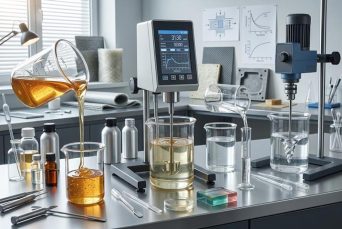
– Required equipment: Stopwatch or gel timer, accurate thermometer, paper cup, glass container, graduated cylinder (cc or ml), syringe, scale, spatula, stirring rod, and water bath.