
 فارسی
فارسی
 English
 العربية
 Русский

Most previous studies have focused on the effects of vacuum, vibration, and compaction on compressive and flexural strength. It is clear that these techniques improve the strength of samples but also increase energy consumption, stone density, and the use of raw materials. It is evident that increasing stone density negatively impacts the seismic performance of structures due to the increase in structural weight. In contrast, there is no study evaluating the effect of different curing conditions on compressive and flexural strength. Finding the optimal curing temperature is important because not only does it not increase the use of artificial stones, but it also does not increase the use of raw materials such as vacuum and vibration compaction. The compressive strength of natural travertine is between 34.5 and 72.4 MPa, and its flexural strength is approximately between 4.1 and 10.3 MPa.
Therefore, a stone with compressive and flexural strength exceeding 34.5 and 4.1 MPa, respectively, can be used as a building material. The compressive and flexural strengths of mix ratios 79, 5, 34 in groups 1-3 are acceptable compared to those of natural travertine stones.
**SEM Analysis**
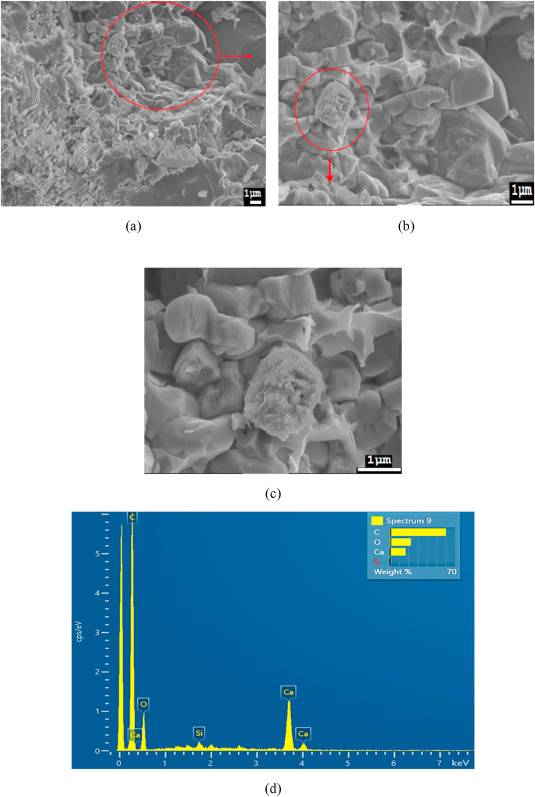
The following figure shows SEM images of P50Sa25S25Eb30T120. Figures (a) and (b) show the size distribution and configuration of solid components in this sample. As shown in this figure, the solid components have roughly angular and sharp corners with sizes ranging from 1 to 7. Figure (c) shows the high surface roughness of the solid components on a microscale. Based on the results obtained from Energy Dispersive Spectroscopy (EDS) analysis in figure (d), the main functional group is carbon.